

SUGGESTED POWDERS:
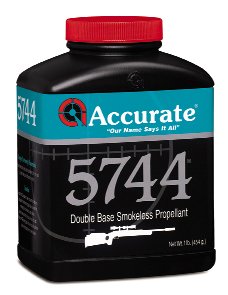
Accurate 5744, 41 to 46 grains with 240 - 300 gr. saboted projectiles. It ignites easily, is clean-burning, meters extremely well, and is very forgiving. It is "THE" powder for the 10ML, if there is such a thing. The Lee Powder Dipper (3.4 cc, capacity of 45.2 grains) charge of Accurate Arms 5744 powder has proven to be an outstanding performer: one of the very best.
The entire Lee Dipper Kit is very affordable at about six bucks, available from Midway USA and other
sources.
The Lee 3.1 cc dipper equals 41.3 grains, and is a very soft recoil load. Accurate 5744 is also a beautifully clean burning powder, and is has been found to be temperature insensitive. It is easily my personal favorite "field powder" choice, and is likely the only powder you will ever need for your Henry Ball Limited Edition. Accurate Arms 5744 will not give you a misfire, under conditions such as less than optimal sabot fit, or neglected breechplugs-- where other powders can, and have. Let's just say it is the only powder I'll ever REALLY need-- the choice is, of course, all yours.
The simple combination of 45.2 grains (Lee 3.4cc dipper) scooped right out of the jar and 300 gr. Barnes MZ-Expanders has accounted for dozens of sub-3/4 MOA groups from four different test guns, with an average muzzle velocity of 2080 fps. This soft-shooting load retains approximately 2000 foot lbs. of energy at 100 yards, and approx. 1375 fpe at 200 yards. This is more than 50 percent more than the long recommended 800 fpe minimum for the ethical harvesting of deer-sized game. You also are assured of 100% weight retention. Far more recoil is available, of course, to those who elect to seek it. The above load is more than generous for clean harvesting of any North American hooved game (at least those not wearing Kevlar vests).
 If
you feel you need for velocity with a 250 grain bullet, Vihtavouri N110 is the Savage recommended powder that best fills the bill. It is a single base powder
that seems best suited for 240 to 250 grain projectiles as it is somewhat fast
burning. Weighing charges of N110 gives clearly greater accuracy vs. scoop loads
in my experience. It is also the powder most often used by Savage
Arms themselves. 42 grains by weight has shown to be a very good
load in several test rifles. N110 currently offers the most muzzle velocity
for your buck. Vihtavouri has been very helpful to the 10ML-II project, and
I happily salute them for that.
If
you feel you need for velocity with a 250 grain bullet, Vihtavouri N110 is the Savage recommended powder that best fills the bill. It is a single base powder
that seems best suited for 240 to 250 grain projectiles as it is somewhat fast
burning. Weighing charges of N110 gives clearly greater accuracy vs. scoop loads
in my experience. It is also the powder most often used by Savage
Arms themselves. 42 grains by weight has shown to be a very good
load in several test rifles. N110 currently offers the most muzzle velocity
for your buck. Vihtavouri has been very helpful to the 10ML-II project, and
I happily salute them for that.
Another very forgiving and easy to work with choice is Vihtavouri N120, also a single base powder. Starting at 55.4 grains (Lee 4.0 cc Dipper) and working up in 2 grain increments is a reasonable approach with 250 gr. genre sabots, until the specific combination that meets your personal needs is found-- 60 to 62 grains has given good results with 240 - 260 gr. sabots. It is also an even BETTER choice for the heavier 300 grain saboted bullets. N120 also meters extremely well. The Vihtavouri propellants are available in 2 lb. bottles as the standard weight. Representative velocities: 55 gr. = approx. 2050 fps w/ 250 gr. sabot, 60 gr. = 2280 fps w/ 300 gr. sabot.
Vihtavouri N120 is THE powder that, in my opinion, need to be added to the Savage 10ML-II manual badly as an official "Savage recommended powder." N120 is very easy to work with.
For 300 gr. - 340 gr. jacketed saboted bullets (or 260 gr. and up pure lead saboted bullets), 60 grains of Alliant "Reloder 7" has been a very reliable performer. You might wish to start with 60 gr. of RL-7, and continue until you find the level of felt recoil that satisfies you. Like 5744, it is a double-base, short-cut extruded powder that meters extremely well, is very forgiving, and is VERY easy to employ with the both the yellow Lee Dipper Set or the Perfect Powder Measure. Alliant Reloder 7 has advantages of good distribution and availability, and is also very easy to ignite. Many may not be aware of the nitro content of Savage compatible Alliant powders, so I'll mention it here: Reloder 7 = 7%, 2400 = 15%, Blue Dot = 20%. I've never had a misfire with Reloder 7, but with light bullets unburnt grains of powder remain. Add more bullet mass, more powder is combusted due to the increase in back pressure. 300 gr. and up bullets give faster velocities than 250 gr. class bullets, with the same powder charge.
Finally, Accurate Arms XMR-2015 is yet another very good 10ML-II powder. It is a single base powder, therefore not as quite as efficient as XMP-5744, nor does it sustain combustion well with very light projectiles or loose fitting sabots. Yet, it has given exemplary accuracy with 300 grain + bullets, and according to the ballisticians at Accurate Arms-- is good for another 200 fps or so assuming the same pressure as 5744 with a 350 gr. bullet. In my opinion, it does not generally beat Accurate Arms 5744, though-- nor does anything else.
This is a matter of personal opinion only: use of any IMR or Hodgdon nitrocellulose-based powder in the Savage 10ML-II is unconscionable. It seems quite silly to burn Hodgdon product in any 10ML-II, as they are clearly and LOUDLY "Anti-Smokeless Muzzleloading." Why would one support a company with their purchase dollars for use in a product that same company remains so remarkably ignorant of? Fortunately, we have Accurate Arms, Alliant Powder, and Vihtavouri providing top-shelf propellants, without the attitude or brilliantly dazzling lack of knowledge displayed by Hodgdon / IMR. It seems a pity that while Savage is happy to recommend Hodgdon Pyrodex in their owner's manual, Hodgdon apparently returns the 'favor' by taking an anti-smokeless muzzleloading stance-- with no actual or factual basis from which to do so. Hodgdon has long been one of my favorite powder companies, and I personally have a great deal of appreciation for them. Savage Arms has never spoken ill of them. I believe Hodgdon and Savage Arms could certainly come to a gentleman's agreement of sorts on the 10ML-II-- presuming that they are both truly "gentlemen."
One pound of powder is 7000 grains. Assuming you settle on a 44 grain charge of 5744, that will give you about 159 shots per one pound bottle. If you compare cost per shot to the three boxes of Triple 7 pellets you need to fire a std. inline 150 times (with a comparatively slow 100 gr. equivalent charge), the cost savings is obvious.
WHERE TO GET POWDER and PRIMERS:
Graf & Sons, Inc., in Mexico, Missouri has a very good selection at excellent prices if your local gunshop does not, including both Accurate Arms and Vihtavouri powders: Call Graf & Sons at 800-531-2666.
VMD VALUES:
"VMD" (Volume Measure Density) is the volume of one grain (by weight) of gunpowder expressed in cubic centimeters. To determine the volume of a powder charge in cc's multiply the grains of powder by the VMD. The VMD is helpful in calculating the yellow Lee dipper, or Lee Perfect Powder Measure setting required to obtain a desired weight of a specific powder.
Blackpowder FFFg = .06280, Blackpowder FFg = .06800
Pyrodex RS = .08110, Pyrodex P = .08230
Accurate Arms 5744 = .07515, Accurate Arms 2015= .07300
Alliant Powder Reloder 7 = .07280 , Alliant 2400 .07420
Vihtavouri N105 = .09001, Vihtavouri N110 = .08330, Vihtavouri N120 = .07760
EXAMPLE: 45.2 grains of Accurate Arms 5744 uses the Lee 3.4 cc dipper. The VMD of 5744 is .07515. 45.2 grains X .07515 = 3.39678 cubic centimeters, or approximately 3.4 cc . High bulk powders tend to be easier to work with than low bulk powders, tend to be more forgiving, and naturally lend themselves extremely well to volumetric measuring. That's but one of the reasons I favor both Accurate Arms 5744, and Vihtavouri N120 for the Savage 10ML-II. All above listed propellants work well with the Savage (and many more); no other muzzleloader ever made can make that claim.
SUGGESTED POWDER MEASURE:
The economical Lee "Perfect
Powder Measure" works well, for those who prefer to premeasure their charges
in quantity: 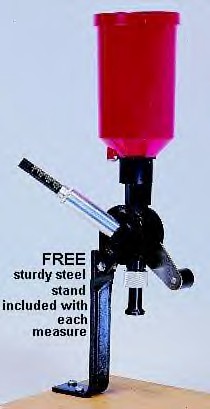 http://www.leeprecision.com
.
http://www.leeprecision.com
.
As supplied, it does a decent job. For even greater accuracy, run a pound of powder through it before using it. The graphite from the powder makes the dropped charges more consistent. Alternately, running some "Motor Mica" through the hopper does the same thing. There is a "drum stop" that allows for using this measure in automatic mode, it is just a plastic tab. Cutting the stop away ( just a quick clip with an Exacto-knife), while disabling auto mode, allows the metering tube to point straight up-- and makes sure that all powder is thrown. A small "tweak," but a worthwhile one. In a very general sense, the "hierarchy of accuracy" trend would be Lee Powder Dippers, then a good powder measure, and at the top-- weighing all charges to within 1/10th of a grain. The very forgiving powders cited (AA 5744) have produced very tight groups even though the charges have varied by as much as one half of one grain in weight.
Those looking for the "top of the line" in drum type powder measures might wish to consider the Harrell's Custom 90 Culver Measure. Available from Harrell Brothers.
10ML-II Propellant Preferences
Preferences is all that is being addressed here, the propellant choices available to the 10ML-II hunter is more divergent than available to the any other muzzleloader available today. With the plethora of propellant options can come needless confusion, for most muzzleloading hunters I know are focused primarily on deer-sized game, and do not care to invest in hundreds of dollars of different propellants. One GOOD propellant choice is what I'm told that most hunters want, once a firearm meets or exceeds your expectations or goals-- very little remains. People are traditionally creatures of habit; once a load performs to an individual's satisfaction, they are loathe to change it without compelling reasons. The closest analogy that springs to mind for me is shotshell reloading. Several hundred thousand rounds ago, I embarked on trying most every wad, hull, primer, and powder combination that was available. Time-consuming, wasteful, a lot of boring time at the patterning board, and shooting through chronographs. Yet, I came to find a few combinations that did what I wanted them to do after all that experimenting, and the confidence that day in, day out performance inspires is hard to displace. So now, in 12 ga., it is American Select on the skeet field, Green Dot for 27 yard trap and race games, and WSF for 1-1/4 oz. pheasant loads. Sporting Clays gets Green Dot in 12 Ga., WSF in 20 gauge. In no way is this condemnation of other shotshell powders, it is just a matter of personal preference. There are an equal number of 12 Ga. shooters who swear by International Clays, PB, Red Dot-- perhaps 700X or Solo 1250. They all go bang; they all have their respective followings. Reloading is a place to exhibit individual preferences, and so it is with muzzleloading-- which is, by nature, reloading. Though the combinations that are practical in the Savage 10ML-II are endless, I have my choices, and reasons why they are my choices. They are mentioned here only to help those who might wish some time, and not embark on their own never-ending story. The commonality to shotshell reloading and smokeless muzzleloading is clear-- both use plastic wads, and relatively large bores. Shotshell loads rarely exceed 12,000 PSI excepting for .410 loads, the Savage window is far more generous.
Ignition is often mentioned as major factor in propellant selection for the 10ML-II, but that is wrong-headed. So is the notion of "maintaining compression on the powder charge," as a plastic sabot can only do so much, and that just isn't much. It is not primary ignition that is the issue at all, but rather sustaining combustion through adequate backpressure. In the hierarchy of primers, 209 shotshell primers produce in the area of 20 cubic centimeters of gas by volume, musket caps 14cc's, large rifle primers 12 cubic centimeters. In the 10ML-II, with no appreciable internal blowback, the gas has nowhere to go but through the breechplug-- showing less leakage than any other muzzleloader made today. Like vinyl shotshell wads, polyethylene sabots have very low coefficients of friction. Due to the high lubricity of today's sabots, backpressure stems primarily from projectile mass.
Shotshell loads can have an added bonus to sustain ignition, and that is the barrel constriction, or choke. Lacking that in the 10ML-II application, we need powders that keep a good backburn going without the benefit of constriction, or the squeezing of cupric-nickel or gilding metal jackets into rifling that gives us more of the same in center-fire rifles. Pyrodex and related synthetic propellants need no significant backpressure to deflagrate, or burn rapidly. Smokeless powder does. Cleanliness of a specific powder is often mentioned, but there is scant basis for that being of much significance. All 10ML-II powders are vividly clean by Pyrodex standards, and the small amount of ash left by even the so-called "dirty" Savage powders needs little attention. It is non-corrosive, and the sabot is a wiper-- so the buildup in not an issue. Like many a shotshell load, your barrel may appear "dirty" after the first shot, but it is self-cleaning in large measure, leaving the bore in a very similar condition after each shot.
You may have read various "load density" theories appertaining to smokeless powder use in cartridges. Those can be set aside in the 10ML-II, as it is a caseless cartridge application-- like all muzzleloaders. The load density is always close to 100%. Finally, there is always a compulsion to use "old powder" or powders that you already have on hand. This is false economy, a waste of time, and any reloading manual warns against such foolishness. The cost of operating a 10ML-II is the lowest of any muzzleloader offered today. The more miserly may think they are saving something by struggling to find a workable load with surplus powder-- but they are just wasting time and energy, in some cases.
ACCURATE 5744
Accurate
5744 has no equal, in my view, for the Savage 10ML-II. It is not a matter of
just one factor, it is a combinatorial situation. No powder is more accurate
when used with Lee Dippers, at least that I have found. That makes it a great
field powder. It also meters well in drum type powder measures, like the Lee
Perfect Powder Measure. By virtue of its short-cut extruded grain shape, its
20% nitro content, and a variety of additives that I'm not able to elaborate
on, it requires very little backpressure for an efficient burn-- and has performed
flawlessly with bullet weights from 195 grains to 360 grains, with no suspicion
of a misfire in some 12 pounds of 5744 I've burned this year. It is easy on
ventliner life as well. It is amazingly consistent pound to pound, lot-to-lot.
Even Accurate Arms powder company has found it to surprisingly consistent over
the years, with long-term sophisticated testing. Alternatively called a rifle
powder (XMR-5744) and a pistol powder (XMP-5744), it has worked so well in both
applications that it is now just "5744." As "Doc" White
reminded me, "it takes a relatively long, relatively heavy bullet to
produce a relatively flat trajectory, although shorter less efficient bullets
have a very modest advantage at the closer ranges. The Express Train bullets
of yesteryear took advantage of that short-range capability, the lighter faster
bullet being meant for closer range shots. This is very confusing to modern
smokeless shooters who have been trained, or brainwashed, to think the other
way around."
One might wonder why a reference to older "Nitro Express" loadings has to do with 5744? The sole quasi-complaint ever mentioned regarding 5744 is that is does not produce the very fastest MUZZLE velocities. Of the Savage recommended loads, N110 does give better velocities-- but by less than 100 fps in many cases. That's at the muzzle, and is virtually meaningless at 200 yards. Let's look at a dose of reality, though: 50 gr. of 5744 gets a .40 cal. 260 grain sabot out of my muzzle at 2138 fps. Using a .273 BC for this bullet, that leaves 1490 foot pounds of terminal energy at 200 yards. This same, identical charge gets a 340 grain lead bullet out at 2080 fps. Again, a conservative BC of .282 is used, resulting in stunning 1908 foot pounds of terminal energy at 200 yards. The trajectories are virtually identical. Both loads have yielded 3/4 MOA accuracy, and exhibit the versatility of what the 10ML-II can really do.
Accurate 5744 is the least affected powder by temperature in the Savage 10ML that I'm familar with. Comparing velocities at 15 degrees F. versus 85 degrees F, the chrono shows only a 25 - 30 fps average variation. The key is that while all single based powders tend to burn slower in colder temperatures, nitroglycerine becomes actually more aggressive. 5744's 20% glyceral trinitrate, and in the 10ML-II application has a self-cancelling effect. While single based powders can slow down in cold weather, 5744 remains constant. It is the supreme 10ML propellant due to this, and the other user-friendly factors cited previously.
VIHTAVOURI N120
As mentioned elsewhere, Vihtavouri N120 is the powder that I'd like to see added as a "Savage Recommended Propellant." Sandwiched right between 4227 and SR4759 on the Vihtavouri burn rate chart (and on Richard Lee's burn rate chart), it is poised to be a more universally used 10ML-II powder. You'll find it used in some .45 / 70 Government loads, and also as 'compressed charges' in the .458 Winchester Magnum, right alongside slower powders such as AA 2015 and Alliant Reloder 7 (both good 10ML powders for bullet weights exceeding 300 grains). A single base powder that has exhibited no ignition problems to date, it does require more substantial charges than the more common, faster burning Savage recommended powders to get things up to speed, 60 grains or so, all depending on what you are looking for (and, of course, your specific rifle and projectile combination). It meters well, and is a very good "middle ground" between the faster N110 that has not performed accurately for me unless carefully weighed, and the slower yet 2015 and Reloder 7 powders that need 340 grain area bullets to become efficient.
60 grains of N120 pushing a 300 gr. Barnes MZ-Expander equals approximately 2280 fps out of my test rifles.
That's a quick peek at two powders I'm personally impressed with. Accurate Arms 5744, both a longtime staple of the 10ML rifle and the very best overall powder I've used for the 10ML-II. Then, Vihtavouri N120: propellant that just begs for far more consideration and general use.
Double Based Backgrounds
In a general and vague sense, common nitrocellulose based powders are grouped into two categories, "Doubled Based" and "Single Based." Single-based smokeless powders are primarily nitrocellulose (cellulose hexanitrate), which began life in a crude form as "guncotton." Doubled based powders are composed of nitrocellulose and nitroglycerin (glyceral trinitrate).
Modern single based powders date back to 1884, and this "Poudre B" was used by the French in the first successful small bore military rifle, the Model 1886 Lebel-- a revolution at the time. The first commercially successful doubled-based powder was invented by Alfred E. Nobel in 1888, marketed as "Ballistite"in 1889. Since 1890 or so, the fundamental chemistry behind today's smokeless powders was established, with those basics not having changed in the last 115 years.
For the 10ML-II, the single based powder most often used is Vihtavouri N110-- all of the Vihtavouri "N100" series is single based, the same with most IMR powders, such as SR-4759. Burn rate is controlled primarily by geometry of the powder, along with a variety of burn retardant additives. Accurate Arms 5744 is a double-based, 20% Nitro content propellant. Most Alliant powders are double based, as are the Olin -Winchester ball powders.
What double-based powders can offer is another option for ballisticians to control ignition, by varying the energy content of the powder in addition to the grain size and form. The addition of nitroglycerin exhibits a plasticizing effect on the powder kernels, making them impervious to moisture changes, and can also make them less affected by significant temperature changes. Though not of great significance in the Savage, by virtue of their higher energy content-- charge weight is often reduced as well; shots per pound are increased in concert.
A SAFETY REMINDER: Safety is seldom the most popular topic, and the Savage 10ML-II is easily the strongest, safest muzzleloader ever made. However, ANY product can be abused or misused. If you are a muzzleloader, you are automatically a reloader. You alone control what enters your rifle's muzzle, and how it enters it-- just like any other muzzleloader. NEVER mix powders, under any conditions-- as CLEARLY warned against by every major powder maker in the world today, gun manufacturers, and every reloading manual as well. "When in doubt, throw it out" is the credo of every intelligent reloader. Use only primers, propellants, and projectiles approved by the Savage Arms Company. You absolutely CANNOT shoot "JUST ANYTHING." If you elect to deviate from that, you are strictly on your own-- and do so at your own risk. If this note saves but ONE injury to shooter or bystander, it is well worth the space taken here. Just as in the case of EVERY firearm, ONLY the manufacturer has any authority to set allowed loads.
© 2004 by Randy Wakeman